Alkali vs Plagioclase Feldspar: Key Differences Explained
When delving into the fascinating world of geology, you'll quickly encounter feldspar minerals - the most abundant mineral group in Earth's crust. Making up approximately 60% of terrestrial rocks, feldspars are literally the foundation of our planet's surface. But did you know there are actually different types of feldspar with unique properties and characteristics? The two major groups - alkali feldspar and plagioclase feldspar - have significant differences that matter to geologists, construction professionals, and even jewelry makers.
I've spent years studying these remarkable minerals, and I'm still amazed by how much their subtle variations can tell us about Earth's geological processes. Whether you're a geology student, a rock enthusiast, or simply curious about the world beneath your feet, understanding the difference between alkali and plagioclase feldspar opens up a new dimension of geological appreciation.
In this comprehensive guide, we'll explore the key distinctions between these important mineral groups, their formation processes, identification methods, and practical applications. Ever wondered why some granites have that beautiful pink coloration while others appear more grayish-white? The answer lies in their feldspar content! Let's dive into the crystalline world of these remarkable rock-forming minerals.
What Are Feldspars? Understanding the Basics
Before we compare the two main types, let's establish what feldspars actually are. Feldspars belong to a group of silicate minerals that form the fundamental building blocks of many igneous, metamorphic, and sedimentary rocks. These minerals share a similar chemical structure based on aluminum silicate frameworks combined with varying proportions of potassium, sodium, and calcium. The specific ratio of these elements determines which type of feldspar we're dealing with.
What makes feldspars so ubiquitous in Earth's crust? Their formation coincides with the cooling of magma - as molten rock solidifies, various minerals crystallize at different temperatures, with feldspars forming during this process. The specific cooling conditions (especially temperature and rate of cooling) play a crucial role in determining which type of feldspar will develop. I've examined rock samples from volcanic regions where rapid cooling created one type of feldspar, while in deeply buried plutonic environments, the slow cooling produced entirely different feldspar varieties.
Feldspars typically display a characteristic property called cleavage - the tendency to break along preferred planes, creating flat, smooth surfaces. This property, along with their hardness (6-6.5 on the Mohs scale) and luster, helps geologists identify them in the field. When I'm out rock hunting, I often carry a small magnifying glass to spot the telltale glassy sheen and cleavage patterns that distinguish feldspars from other minerals.
Now, let's explore the distinctive characteristics of the two major feldspar families that make them unique from each other - the alkali feldspars and the plagioclase feldspars.
Alkali Feldspar: Composition, Properties, and Occurrence
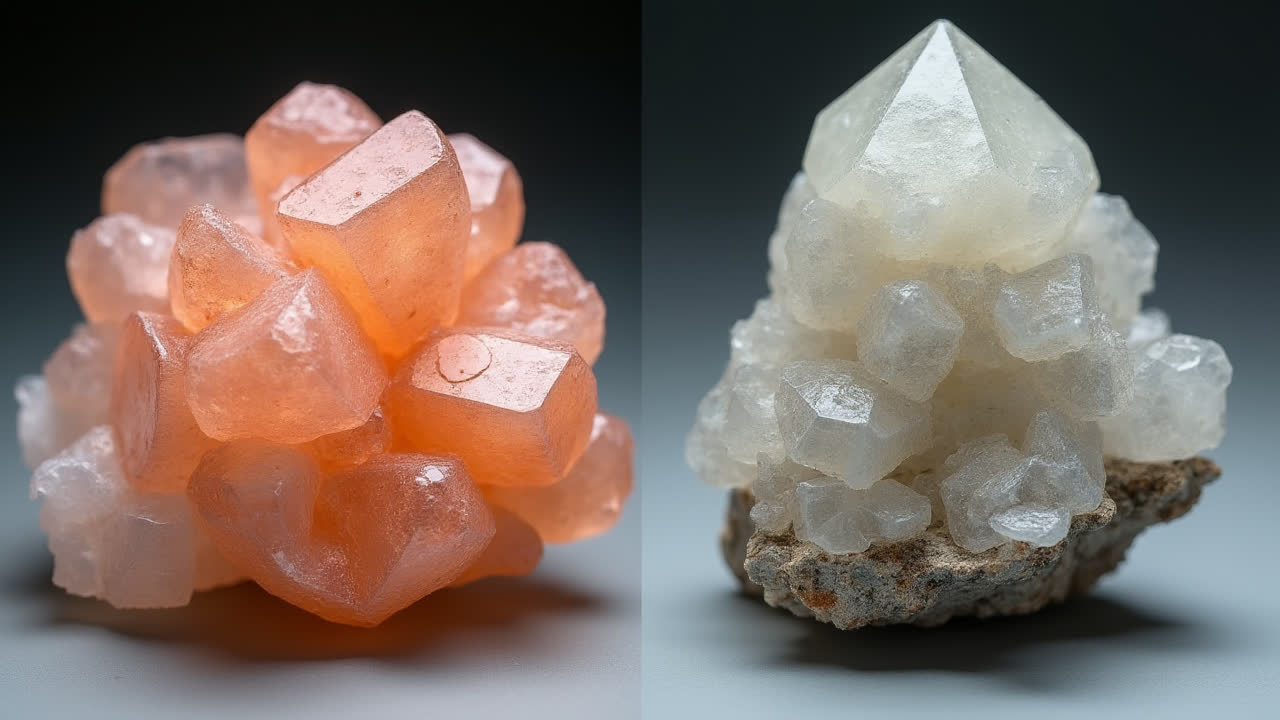
Alkali feldspars, sometimes called potassium feldspars or K-feldspars, are characterized by their significant potassium and sodium content. The chemical formula typically follows (K,Na)AlSi₃O₈, with potassium usually dominating in most varieties. What fascinates me most about alkali feldspars is their incredible color range - from the snow-white varieties to stunning brick-red specimens that can transform an ordinary rock into a visual masterpiece.
The most common types of alkali feldspar include orthoclase, microcline, and sanidine. Each has its own crystal structure and formation conditions. Orthoclase, with its monoclinic crystal structure, typically appears pink or white and is commonly found in granite. Microcline, sporting a triclinic structure, is actually the most abundant K-feldspar on Earth and often displays cream or white coloration. Then there's sanidine, another monoclinic variety that forms in high-temperature environments and can appear clear or yellowish. The anomaly in the alkali feldspar family is anorthoclase, which unlike its potassium-rich relatives, contains more sodium than potassium.
The cooling history of the parent magma plays a decisive role in determining which specific type of alkali feldspar will form. For instance, when visiting volcanic sites in Iceland last year, I noticed how sanidine dominated in rocks that had undergone rapid cooling, preserving its high-temperature crystal structure. In contrast, rocks from ancient plutonic bodies that cooled slowly over millions of years contained abundant microcline, which forms at lower temperatures.
Where are you most likely to find alkali feldspars? They're particularly abundant in felsic igneous rocks like granite, where their content can exceed 20% of the rock's volume. They're also present in certain metamorphic rocks and even in some sedimentary formations. When you see a granite countertop with beautiful pink crystals sparkling in the light, you're admiring alkali feldspars that formed deep within the Earth millions or even billions of years ago!
Plagioclase Feldspar: The Continuous Series
Unlike the potassium-dominated alkali feldspars, plagioclase feldspars form a continuous solid solution series between sodium-rich albite (NaAlSi₃O₈) and calcium-rich anorthite (CaAl₂Si₂O₈). This means plagioclase can exist with any ratio of sodium to calcium between these two end members, creating what geologists call a solid solution series. I find this property particularly interesting because it allows plagioclase to serve as a natural thermometer - the calcium content can tell us about the temperature conditions when the mineral formed.
One of the most distinctive features of plagioclase feldspars is the presence of fine parallel lines or grooves on one cleavage surface, known as striations. These result from twinning - a crystallographic phenomenon where crystals grow together in a symmetrical fashion. The first time I spotted these striations under a hand lens during a field trip to the Canadian Shield, I was amazed at how this microscopic feature could be so crucial for mineral identification. These striations are absent in alkali feldspars, making them a key diagnostic feature.
Plagioclase feldspars typically appear white or gray, though some varieties can show iridescence or color play when viewed from certain angles. This optical property, known as labradorescence in the variety labradorite, creates stunning blue, green, or gold flashes that have made these minerals popular in decorative applications and jewelry. I have a small polished piece of labradorite on my desk that never fails to catch visitors' attention with its color shifts.
In terms of occurrence, plagioclase is incredibly versatile, appearing in virtually all types of igneous rocks. However, the specific composition varies predictably with rock type. Sodium-rich plagioclase dominates in felsic rocks like granite, while calcium-rich varieties are more common in mafic rocks like basalt. This systematic variation, known as Bowen's reaction series, demonstrates how magma evolution influences mineral composition - a concept I find endlessly fascinating when studying volcanic systems.
Comparing Alkali and Plagioclase Feldspar: Key Differences
| Feature | Alkali Feldspar | Plagioclase Feldspar |
|---|---|---|
| Chemical Composition | Rich in potassium and sodium (K,Na)AlSi₃O₈ | Continuous series between sodium and calcium NaAlSi₃O₈ - CaAl₂Si₂O₈ |
| Crystal Structure | Monoclinic or triclinic depending on variety | Exclusively triclinic |
| Surface Features | Generally smooth cleavage surfaces | Fine parallel striations on cleavage surfaces |
| Color Range | White, pink, salmon-red, gray, or green | Typically white to gray, rarely colored |
| Geological Occurrence | Predominantly in felsic rocks (granite, rhyolite) | Found across the spectrum from felsic to mafic rocks |
| Common Varieties | Orthoclase, microcline, sanidine, anorthoclase | Albite, oligoclase, andesine, labradorite, bytownite, anorthite |
| Temperature Formation | Specific varieties form at different temperature ranges | Continuous series with Ca-rich forms at higher temperatures |
| Commercial Uses | Ceramics, glass manufacturing, some gemstones | Building materials, ceramics, decorative stones (especially labradorite) |
Identification Methods: How to Distinguish Between Feldspar Types
For geology enthusiasts and professionals alike, being able to identify feldspar types in the field or lab is an essential skill. I remember struggling with this early in my studies until a professor shared some practical techniques that made the process much clearer. So how can you tell these minerals apart without specialized equipment?
The most reliable visual clue for distinguishing plagioclase from alkali feldspar is the presence of striations. If you have a hand lens or magnifying glass, examine the cleavage surfaces carefully. Those fine, parallel lines (reminiscent of the barcode on your grocery products) are a dead giveaway for plagioclase. Alkali feldspars generally lack these striations, though rare instances of cross-hatched twinning can occur in microcline.
Color can be helpful but isn't always definitive. While that beautiful salmon-pink or brick-red color strongly suggests alkali feldspar (particularly orthoclase or microcline), white specimens could be either type. Similarly, the distinctive blue-green-gold flash of labradorescence immediately identifies a specimen as the plagioclase variety labradorite. During a recent field trip to Labrador, Canada (where this mineral was first described), I was astounded by how vividly these colors play across freshly exposed surfaces.
For those with access to more advanced techniques, optical properties under a polarizing microscope offer definitive identification. The extinction angles, twinning patterns, and optical orientation provide clear differentiation between feldspar types. I'll never forget my excitement when I first observed the characteristic tartan plaid pattern of microcline under crossed polars - it's like the mineral has its own signature pattern!
Chemical tests can also be revealing. For instance, when stained with sodium cobaltinitrite, potassium-rich alkali feldspars turn yellow, while plagioclase remains unchanged. This simple test has saved me countless hours of uncertainty when mapping complex granite bodies with multiple feldspar phases. For more precise determination, X-ray diffraction or electron microprobe analysis can provide the exact chemical composition and crystal structure, though these techniques are typically available only in specialized laboratories.
Geological Significance and Formation
The distribution and composition of feldspars in rocks tell geologists a compelling story about Earth's processes. In igneous rocks, feldspar composition directly reflects the chemistry of the parent magma and its cooling history. When studying volcanic systems in Hawaii, I noticed how the feldspar composition changed systematically from the early-formed mafic lavas (rich in calcium plagioclase) to the later felsic eruptions (dominated by sodium plagioclase and alkali feldspar).
Bowen's reaction series, a fundamental concept in igneous petrology, demonstrates how plagioclase composition evolves continuously as magma cools. Calcium-rich anorthite crystallizes at higher temperatures (around 1100-1550°C), while sodium-rich albite forms at lower temperatures (around 900-1100°C). Alkali feldspars typically form at even lower temperatures (about 700-900°C). This sequence provides clues about the cooling pathway of magma bodies and helps reconstruct the thermal history of igneous systems.
In metamorphic rocks, feldspar transformations reflect changing pressure and temperature conditions. For example, the conversion of albite to jadeite under high-pressure conditions marks the transition to eclogite facies metamorphism - conditions typically associated with subduction zones. During my research in the Alps, finding these minerals helped map ancient subduction boundaries where oceanic crust once plunged beneath continental margins.
Even in sedimentary environments, feldspars provide valuable information. Their presence or absence in sandstones indicates the maturity of the sediment and the intensity of weathering processes. In arid regions, feldspar-rich sandstones (arkoses) commonly form because chemical weathering is limited. In contrast, humid tropical environments promote feldspar decomposition, resulting in quartz-rich sands. When analyzing sediment cores from different climate zones, I've used feldspar content as a proxy for paleoclimate conditions - a fascinating application of mineralogical knowledge to environmental reconstruction.
Practical Applications of Feldspars
Beyond their geological significance, feldspars play crucial roles in various industries. The ceramic and glass industries are perhaps the largest consumers of feldspar minerals. Their aluminum content increases the durability and resistance of ceramic products, while their alkali content (sodium and potassium) serves as a flux, lowering the melting temperature during manufacturing. That elegant porcelain dinnerware in your cabinet likely contains significant amounts of feldspar!
In the construction industry, crushed feldspar serves as an aggregate in concrete and asphalt mixtures. The durability and abundance of these minerals make them cost-effective fillers for various building materials. Additionally, certain feldspar varieties, particularly the more attractive plagioclase types like labradorite and spectrolite, find applications as decorative stones in architecture and interior design. I've seen stunning countertops and wall panels made from labradorite that transform ordinary spaces into visual masterpieces with their play of colors.
The jewelry industry also utilizes select feldspars. Moonstone (a variety of orthoclase with a unique light-scattering property called adularescence) creates a floating light effect that jewelers have prized for centuries. Labradorite, with its spectacular color play, appears in statement pieces that catch and reflect light in mesmerizing ways. A jeweler friend once told me that working with these feldspars is like "capturing lightning in a stone" - a poetic but apt description of their optical properties.
In more specialized applications, certain feldspars serve as industrial fillers in paints, plastics, and rubber products. Their relative softness (compared to minerals like quartz) makes them less abrasive to processing equipment while still providing necessary bulk and physical properties. Some alkali feldspars even find use in mild abrasives, where their hardness provides cleaning action without excessive scratching.
Frequently Asked Questions About Feldspars
How can you tell the difference between plagioclase and alkali feldspar in the field?
The most reliable field method is to look for striations (fine parallel lines) on the cleavage surfaces using a hand lens. Plagioclase typically displays these striations, while alkali feldspar usually doesn't. Color can also provide clues - pink or salmon-colored feldspars are typically alkali varieties, while white to gray specimens with visible striations are likely plagioclase. Additionally, the rock type context offers important hints: in granite, both types commonly occur together, with alkali feldspar often appearing as larger crystals, while in basalt, only plagioclase is typically present.
Why are feldspars important in the ceramic industry?
Feldspars serve multiple critical functions in ceramic manufacturing. First, they act as fluxes that lower the melting temperature of the ceramic mixture, reducing energy costs and making production more efficient. Second, they contribute aluminum to the melt, which increases the viscosity and stability of the glaze, preventing unwanted running or dripping during firing. Third, feldspars improve the strength, durability, and translucency of the finished ceramic products. Finally, they help control thermal expansion, reducing the risk of cracking during the cooling phase. Approximately 20% of global feldspar production goes into ceramics, making it one of the industry's most important non-clay components.
What causes the color variation in feldspars, particularly the pink color in some alkali feldspars?
The distinctive pink to salmon-red color commonly seen in alkali feldspars (particularly orthoclase and microcline) is primarily caused by microscopic inclusions of hematite (iron oxide) within the crystal structure. These tiny iron-bearing particles form during cooling as trace amounts of iron in the original magma oxidize and precipitate within the feldspar. The intensity of the color relates to both the concentration of these inclusions and their size distribution. Other color variations in feldspars can result from different trace elements: greenish hues sometimes indicate copper compounds, while the spectacular blue-green-gold flashes in labradorite result not from inclusions but from light interference within the crystal structure - specifically from thin layers formed during a process called exsolution.
Conclusion
The primary difference between alkali and plagioclase feldspar lies in their chemical composition - alkali feldspars are rich in potassium and sodium, while plagioclase feldspars contain varying proportions of sodium and calcium. This fundamental distinction drives their different crystal structures, physical properties, occurrence patterns, and economic applications.
Understanding the differences between these feldspar types provides valuable insights into Earth's geological processes. From the fiery depths of magma chambers to the slow metamorphic transformations deep within mountain belts, feldspars record the conditions of their formation in their composition and structure.
Whether you're a geology student trying to identify minerals in the field, a homeowner selecting a granite countertop, or simply a curious mind wondering about the colorful crystals in a rock sample, the world of feldspars offers fascinating discoveries. Next time you encounter a rock with visible crystals, take a closer look - you might be able to distinguish between alkali and plagioclase feldspars using the identification tips from this article!
As we continue to study these abundant minerals, new applications and insights emerge. From traditional uses in ceramics and glass to emerging technologies in materials science, feldspars remain as relevant today as they have been throughout human history. And geologically speaking, they'll continue to form and transform as part of Earth's dynamic systems for millions of years to come, telling the silent story of our planet's evolution through their crystalline structures.