Essential Differences Between Annealing, Hardening and Tempering Explained
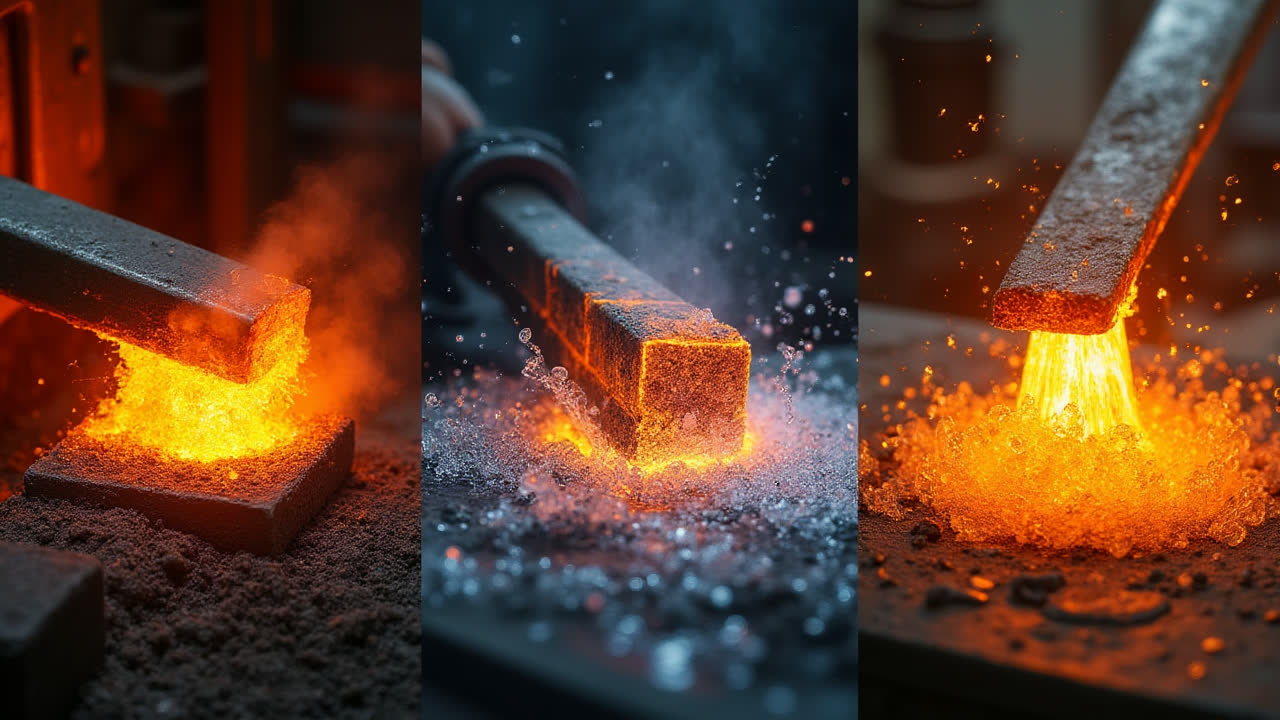
Heat treatment processes are fundamental to metalworking and can dramatically alter the properties of metals and alloys. Whether you're working with steel for a knife blade or modifying components for machinery, understanding the key differences between annealing, hardening, and tempering is crucial for achieving desired material properties. These techniques have been refined over centuries of metallurgical practice, each serving unique purposes in metal fabrication and engineering.
I've worked with various metals in both professional and hobbyist settings, and I've seen firsthand how choosing the right heat treatment can make or break a project. The science behind these processes might seem complicated at first, but once you grasp the basic principles, you'll understand how to manipulate metal properties to suit your specific needs. Let's dive into what makes each of these processes distinct and when you might want to use one over the others.
What Is Annealing in Metallurgy?
Annealing is essentially a softening process that makes metals more workable. When I first learned about annealing, I was surprised by how dramatically it can change a metal's properties. The process involves heating a metal to or near its critical temperature—the point at which its crystalline structure changes—and then cooling it very slowly, typically in an oven. This slow cooling is what gives annealed metals their characteristic softness and ductility.
The primary purpose of annealing is to relieve internal stresses, increase softness, and improve machinability. When metals are worked through processes like forming, welding, or machining, they build up internal stresses that can lead to warping or cracking. Annealing effectively "resets" the metal's structure, relieving these stresses and preparing it for further fabrication.
Different metals require different annealing approaches. Ferrous metals (those containing iron) are typically categorized as either fully annealed (using a very slow cooling process) or process annealed (with a somewhat faster cooling rate). Non-ferrous metals like copper, brass, and silver are often annealed and then quickly cooled by quenching in water—a practice that might seem counterintuitive if you're familiar with hardening processes, but works differently due to these metals' distinct crystalline structures.
I once annealed a copper pipe that had become too brittle from work hardening during a plumbing project. After heating it to a dull red and allowing it to cool slowly, the difference was remarkable—the previously rigid pipe became malleable enough to bend without cracking. This practical application demonstrates why annealing is so valuable in both industrial processes and smaller-scale projects.
Understanding the Hardening Process
Hardening, sometimes called quenching, stands in direct contrast to annealing. While annealing softens, hardening increases the strength and hardness of suitable metals and alloys. This process typically involves heating the metal to its austenitic phase (a specific crystalline structure) and then rapidly cooling it. The rapid cooling, which can be accomplished using water, oil, brine, or even forced air depending on the specific alloy, "locks" the metal's structure in a harder state.
It's worth noting that not all metals can be effectively hardened through this process. The material must contain sufficient carbon and alloy content to respond to hardening treatments. Steel alloys are particularly well-suited to hardening, while pure iron or low-carbon steels won't harden significantly no matter how quickly they're cooled.
There are two primary approaches to hardening: surface hardening and case hardening. Surface hardening, as the name suggests, increases the hardness of just the outer surface while leaving the core relatively soft. This creates a wear-resistant exterior while maintaining a tougher, more impact-resistant interior. Methods for surface hardening include:
- Carburizing - placing the metal in a high-temperature, carbon-rich environment for several hours
- Nitriding - using nitrogen and heat to create a hard surface layer, commonly used for components like fuel injection pumps
- Flame or induction hardening - applying intense heat briefly followed by immediate quenching
Case hardening, meanwhile, works by infusing elements into the metal's surface to create a thin layer of harder alloy. This technique is particularly useful for increasing wear resistance in mechanical components without changing the properties of their interior structure, maintaining a good balance between hardness and toughness.
I've seen impressive results with induction hardening on tool steel. The process created a component with excellent wear resistance on its working surfaces while the core remained tough enough to resist cracking under stress—a perfect example of how hardening can be tailored to specific applications.
The Tempering Method Explained
Tempering addresses a critical issue with hardened metals: excessive brittleness. While hardening increases strength, it can make metals too brittle for practical use. Have you ever wondered why a glass-hard knife would actually make a terrible tool? It would likely chip or shatter on first impact despite being theoretically "harder." This is where tempering comes in—it's the crucial follow-up to hardening that balances hardness with toughness.
The tempering process involves re-heating previously hardened metal to a temperature below its critical point, holding it at that temperature for a specific period, and then cooling it either in air or through quenching. The exact temperature used directly affects the final hardness—higher tempering temperatures reduce hardness while increasing toughness and ductility.
For steel, tempering produces distinctive colors that historically helped blacksmiths determine the appropriate treatment for specific tools. A pale yellow indicates minimal tempering (around 176°C), suitable for tools requiring maximum hardness like razors. Blues and purples appear at higher temperatures (around 300°C), appropriate for springs and saws that need more flexibility. These colors result from oxide layers forming on the steel's surface and can serve as useful visual indicators during the process.
Austempering is a specialized sub-category of tempering primarily applied to ferrous metals like steel and ductile iron. This process aims to improve mechanical properties while reducing or eliminating distortion—a common problem with conventional quenching and tempering. Austempering creates a more uniform microstructure throughout the material, resulting in superior toughness and reduced internal stress.
In my workshop, I've used tempering to restore the toughness of hardened carbon steel blades. After quenching a knife blade to maximum hardness, it was too brittle for practical use—the edge would chip rather than deform under pressure. Tempering at around 205°C (400°F) for an hour gave the perfect balance of edge-holding ability and resilience. Finding this sweet spot is what makes tempering such a valuable skill in metalworking.
Comparative Analysis: Annealing vs. Hardening vs. Tempering
When deciding which heat treatment process is appropriate for your project, it's essential to understand how these methods compare across different dimensions. Each process serves distinct purposes and yields different outcomes, making them suitable for specific applications in metalworking and manufacturing.
| Feature | Annealing | Hardening | Tempering |
|---|---|---|---|
| Primary Purpose | Softens metals, increases ductility | Increases hardness and strength | Reduces brittleness while maintaining hardness |
| Temperature | At or near critical temperature | Above critical temperature (austenitic phase) | Below critical temperature |
| Cooling Method | Very slow cooling (often in an oven) | Rapid cooling (quenching in water, oil, etc.) | Controlled cooling after reheating |
| Material Suitability | Most metals and alloys | Carbon-rich alloys (like steel) | Previously hardened metals (mainly steel) |
| Effect on Microstructure | Refined, stress-free grain structure | Formation of martensite (hard structure) | Transformation of martensite to tempered martensite |
| Common Applications | Preparation for machining, stress relief | Tools, wear surfaces, cutting implements | Springs, gears, knife blades, industrial tools |
| Resulting Properties | Soft, ductile, easily machined | Hard, strong, but brittle | Balanced hardness and toughness |
| Typical Sequence | Often first in manufacturing process | Usually follows annealing, precedes tempering | Final process after hardening |
Practical Applications in Industry and DIY Projects
Understanding when to apply each heat treatment process can make the difference between success and failure in both industrial settings and personal projects. Each technique finds its place in specific applications based on the required material properties.
Annealing is widely used in manufacturing processes where metals need to be formed, machined, or worked extensively. In automotive manufacturing, sheet metal is often annealed before being stamped or pressed into complex shapes to prevent cracking or tearing. For DIY enthusiasts, annealing is invaluable when working with copper pipes or brass sheets that have become work-hardened and difficult to manipulate. I've found annealing particularly useful when restoring antique metal items that need reshaping without risking fractures.
Hardening processes are essential for applications requiring wear resistance and increased strength. Industrial cutting tools, drill bits, and forming dies rely on proper hardening to maintain their edge and shape under extreme conditions. Surface hardening techniques like carburizing and nitriding are widely used for gears and bearing surfaces in automotive and machinery applications. In a home workshop, selective hardening of knife edges, wood chisels, or punches can dramatically improve their performance and longevity.
Tempering finds its place wherever a balance between hardness and toughness is required. Without tempering, hardened components would be too brittle for practical use in most applications. Springs, sword blades, and mechanical components subject to impact or cyclic stress all benefit from careful tempering. I've personally experienced the importance of proper tempering when making garden tools—a correctly tempered pruner blade will hold its edge while resisting chipping or breaking when encountering unexpected hard wood or wire.
The combination of these processes often yields the best results. For example, a high-quality knife typically undergoes a sequence of annealing (for initial shaping), hardening (for edge retention), and tempering (for toughness). This integrated approach to heat treatment is what allows materials to achieve seemingly contradictory properties—being both hard enough to cut effectively and tough enough to withstand impact.
Common Mistakes and Troubleshooting
Even experienced metalworkers can encounter challenges when performing heat treatments. Recognizing common pitfalls and understanding how to address them can save considerable time and frustration. Throughout my years working with metals, I've made my share of mistakes and learned valuable lessons along the way.
One frequent error in annealing is insufficient heating or uneven temperature distribution. Metals must reach their critical temperature throughout the entire piece to achieve proper annealing. Using temperature-indicating paints or working in reduced lighting conditions (where the color of the heated metal is more visible) can help ensure adequate heating. Another mistake is cooling too rapidly—even non-ferrous metals that can be water-quenched after annealing should be fully heated before quenching to avoid thermal shock and uneven properties.
In hardening processes, problems often arise from incorrect quenching media or techniques. Using water for alloys that require oil quenching typically results in cracking due to overly rapid cooling. Conversely, using oil when water is called for may not achieve sufficient hardness. Uneven quenching can create internal stresses that lead to warping or delayed cracking. Ensuring the piece is moved continuously during quenching and maintaining adequate volume and temperature of the quenching medium can help prevent these issues.
Tempering mistakes commonly involve inaccurate temperature control or insufficient holding time. Without precise temperature measurement, achieving consistent results is nearly impossible. Even small variations can significantly affect the final properties—this is why commercial heat treatment operations use carefully calibrated furnaces. For home workshops, using a quality oven thermometer and allowing extra time for thorough heating can improve consistency. I've found that documenting successful tempering parameters (time, temperature, and cooling method) for specific alloys creates a valuable reference for future projects.
Successful heat treatment also depends on understanding the specific alloy being worked. Different steel grades, for instance, respond very differently to the same treatment. What works perfectly for one alloy might produce disappointing results in another with only slightly different composition. When working with unfamiliar materials, consulting reference materials or conducting small-scale tests before treating valuable components can prevent costly mistakes.
Frequently Asked Questions
Can all metals be annealed, hardened, and tempered?
No, not all metals respond to all three heat treatment processes. While most metals can be annealed, hardening and tempering are primarily effective on carbon-containing ferrous alloys like steel. The carbon content is crucial for hardening—low-carbon steels (mild steel) cannot be significantly hardened through conventional quenching. Non-ferrous metals like copper, aluminum, and brass can be annealed but typically don't respond to traditional hardening and tempering processes. Instead, these metals often gain strength through work hardening or precipitation hardening techniques that operate on different principles than those used for steel.
What equipment do I need for basic heat treatment at home?
For basic home heat treatment, you'll need a heat source capable of reaching appropriate temperatures—typically a propane forge, induction heater, or kiln for hardening and annealing, and a household oven for lower-temperature tempering. Temperature measurement is crucial, so invest in pyrometers, temperature-indicating crayons, or an infrared thermometer. For quenching, have containers of appropriate media (water, oil, or air cooling setups) ready before heating begins. Safety equipment is non-negotiable: heat-resistant gloves, eye protection, and proper ventilation are essential. For precision work, consider adding a digital temperature controller to maintain specific temperatures during critical processes like tempering.
How can I determine if a metal has been properly heat treated?
Verifying successful heat treatment typically involves testing the resulting material properties. For hardened components, a file test is a simple method—a standard file should skate across properly hardened steel without biting in. More precise measurement uses hardness testing equipment like Rockwell or Brinell hardness testers. For annealed metals, checking malleability and ductility through bending tests can confirm successful treatment. Commercial operations often examine microstructure using metallurgical microscopes to verify the expected crystalline formations. For practical purposes, performance testing in the intended application provides the most relevant validation—a properly tempered spring should flex and return to shape, while a well-hardened cutting edge should maintain sharpness through normal use.
Conclusion
The differences between annealing, hardening, and tempering represent fundamental approaches to controlling metal properties through heat treatment. While annealing creates soft, workable metals by slow cooling from high temperatures, hardening increases strength and hardness through rapid cooling, and tempering balances hardness with toughness by reheating previously hardened metals to controlled temperatures.
Understanding these processes empowers both professional metalworkers and hobbyists to achieve desired material properties for specific applications. The science behind heat treatment has been refined over centuries, but the basic principles remain consistent—control over heating, cooling, and the resulting microstructure determines how metals perform in service.
Whether you're crafting a knife, rebuilding an engine, or designing industrial components, choosing the appropriate heat treatment process can make the difference between success and failure. By mastering these techniques, you gain the ability to enhance the performance and longevity of metal components in countless applications. The next time you pick up a finely made tool or examine a precision machine part, take a moment to appreciate the careful heat treatment that likely went into making it both hard enough and tough enough for its intended purpose.
References:
- http://www.slideshare.net/himanshuverma575/heat-treatment-processes-75
- http://www.metlabheattreat.com/metal-hardening-metal-quenching-metal-t
- http://www.slideshare.net/e_gulfam/hardening-heat-treatment-quenching
- https://commons.wikimedia.org/w/index.php?curid=20076318
- https://commons.wikimedia.org/w/index.php?curid=19629816
- https://commons.wikimedia.org/w/index.php?curid=18561876