Church vs Cathedral: 7 Key Differences You Should Know
What Defines a Church?
A church is fundamentally a building designed for Christian worship. When we talk about churches, we're referring to places where Christians gather to pray, participate in religious services, and form community. I remember visiting a small village church in rural England that could barely fit fifty people, yet it served as the heart of the community for centuries.
The term "church" is actually quite versatile in the English language. It can refer to three distinct concepts:
- The physical building where worship takes place
- A Christian organization with its own clergy, buildings, and distinctive doctrines
- The broader Christian religion itself
Churches vary enormously in size and grandeur. You'll find them in both bustling cities and quiet villages, serving communities large and small. Most churches have at least one pastor or priest who leads the congregation in worship. While religious services can be held throughout the week, the main service or mass typically occurs on Sundays.
Interestingly, though we commonly associate the word "church" with Christianity, the term can occasionally be applied to other religions' places of worship as well. This linguistic flexibility shows how deeply embedded the concept is in our cultural understanding of religious spaces. Doesn't it make you wonder how language shapes our perception of sacred places?
What Makes a Cathedral Special?
A cathedral is not just any church—it's a church with a specific designation and purpose. The word "cathedral" derives from the Latin word "cathedra," which means "chair" or "throne." This refers to the bishop's seat, which is both literal and symbolic of the bishop's authority.
Cathedrals serve as the principal church within a diocese, which is an ecclesiastical district under the jurisdiction of a bishop. Think of it as the headquarters or home base for the bishop's ministry. When I first visited Notre Dame in Paris (before the fire), I was struck by how the architecture seemed designed to emphasize the bishop's throne at the heart of this massive structure.
Cathedrals are most commonly found in Roman Catholic, Anglican, and Orthodox Christian traditions. In the Orthodox Church, cathedrals come in two varieties:
- The main church of a diocese, which houses the bishop's seat
- A major church in a specific region, city, or town that has been granted cathedral status even if it's not the bishop's seat
One fascinating aspect of cathedrals is that the designation can move. If a bishop's seat relocates to another church, that church becomes the new cathedral. The building doesn't make the cathedral—the bishop's presence does! This mobility highlights the importance of the human element in religious institutions, rather than just the physical structures themselves.
Architectural Differences Between Churches and Cathedrals
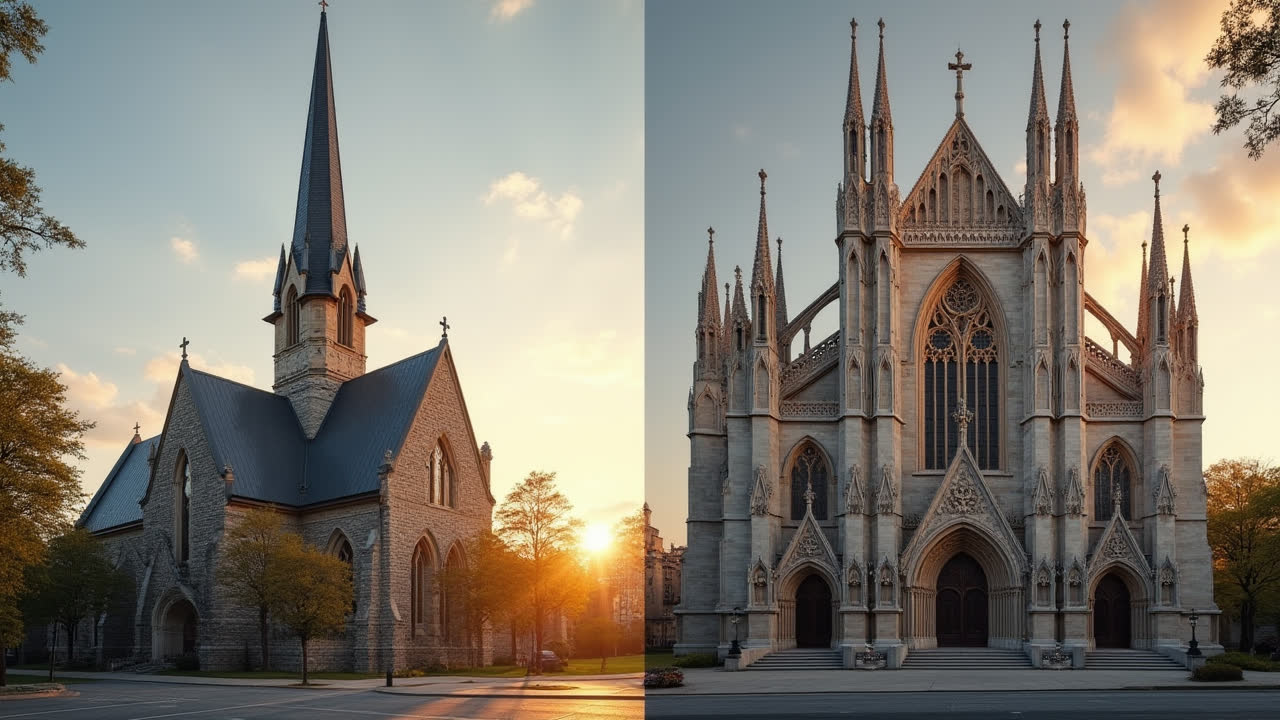
While not a defining characteristic, cathedrals tend to be more architecturally impressive than ordinary churches. They're typically larger, more elaborate, and feature more intricate design elements. This architectural grandeur isn't merely decorative—it serves to emphasize the cathedral's importance as the center of diocesan life.
Medieval cathedrals particularly showcase this distinction. They often took centuries to build and represented the pinnacle of architectural achievement for their time. Gothic cathedrals like Chartres or Canterbury feature soaring spires, flying buttresses, and spectacular stained glass windows that create an atmosphere of transcendence. I've spent hours in these spaces, neck craned upward, wondering how medieval builders achieved such feats without modern technology.
Churches, by contrast, can range from humble country chapels to impressive urban structures. Their architectural styles are just as diverse as their sizes and locations. A small parish church might be a simple rectangular building with a modest bell tower, while a large city church could rival a small cathedral in size and decoration.
The interior layout also differs. Cathedrals typically have a cruciform (cross-shaped) floor plan with a long nave, transepts (the arms of the cross), and a choir area near the altar. Many also contain side chapels, elaborate choir stalls, and a prominent space for the bishop's cathedra. Churches might have simpler layouts, though this varies widely depending on denomination, age, and location.
Historical and Religious Significance
The distinction between churches and cathedrals carries deep historical significance. In medieval Europe, cathedrals weren't just religious centers—they were educational, cultural, and political hubs as well. The cathedral was often the most important building in a city, representing not only God's presence but also human achievement and civic pride.
Cathedrals frequently housed religious relics and became destinations for pilgrims. This pilgrimage traffic could transform a city's economy and importance. For example, Canterbury Cathedral's fame grew enormously after Thomas Becket's martyrdom there in 1170, bringing pilgrims (and their money) from across Europe.
From a religious perspective, cathedrals embody the hierarchical structure of denominations like Catholicism and Anglicanism. The cathedral represents the bishop's authority and connection to apostolic succession—the unbroken line of ordination supposedly stretching back to Christ's apostles. This centralization of authority contrasts with denominations that emphasize individual congregations' autonomy.
Churches, meanwhile, represent Christianity at the community level. They're where most believers experience their faith week to week. While perhaps less impressive architecturally than cathedrals, local churches often hold deeper personal significance for individual Christians, serving as the backdrop for life's most meaningful moments—baptisms, weddings, funerals, and weekly worship.
Modern Understanding and Usage
In contemporary usage, the distinction between churches and cathedrals sometimes blurs. Many people use "church" as a catch-all term for any Christian place of worship. And who can blame them? The technical differences matter primarily to clergy and church historians, not to the average visitor or worshipper.
That said, cathedrals continue to hold special status. They often serve as tourist attractions due to their historical and architectural significance. Even in increasingly secular societies, cathedrals remain powerful symbols of cultural heritage. I've noticed how even non-religious friends are moved by the atmosphere inside great cathedrals—there's something about these spaces that transcends their strictly religious purpose.
The modern era has also introduced new complexities. Some very large, non-cathedral churches are now called "mega-churches," particularly in evangelical Protestant traditions that don't have bishops. These enormous structures can accommodate thousands of worshippers and often include facilities more commonly associated with community centers or entertainment venues. Are they more like cathedrals or churches? The traditional definitions don't quite capture their nature.
And what about digital spaces? As online worship becomes more common, especially following the COVID-19 pandemic, we might ask whether the distinction between cathedral and church has any meaning in virtual environments. Can a Zoom service be cathedral-like? These questions remind us that religious terminology continues to evolve alongside religious practice.
Church vs Cathedral: Key Differences Comparison
| Feature | Church | Cathedral |
|---|---|---|
| Basic Definition | A building used for Christian worship | The principal church of a diocese, containing the bishop's seat |
| Religious Authority | Led by priests, pastors, or ministers | Official seat of a bishop |
| Typical Size | Varies widely, often smaller | Usually larger and more architecturally significant |
| Geographical Presence | Found in cities, towns, and villages | Typically one per diocese or major city |
| Religious Traditions | Found in all Christian denominations | Primarily in Catholic, Anglican, and Orthodox traditions |
| Interior Features | Simpler altar and sanctuary areas | Contains a cathedra (bishop's throne) and often more elaborate decoration |
| Historical Significance | Local or community importance | Often has regional or national significance |
| Architectural Style | Varies widely, often reflects local traditions | Frequently showcases the height of architectural achievement for its era |
Frequently Asked Questions About Churches and Cathedrals
Can a cathedral also be a parish church?
Yes, a cathedral can simultaneously function as a parish church. Many cathedrals serve dual roles, acting as both the bishop's seat and the primary worship place for a local parish community. This dual function is particularly common in smaller dioceses or cities where maintaining separate buildings would be impractical. The congregation that regularly worships at the cathedral forms the cathedral parish, with its own parish priest who may be called a cathedral dean or rector.
Why are some churches called basilicas?
A basilica is yet another designation for certain churches, primarily in the Roman Catholic tradition. Originally, "basilica" referred to a specific architectural style derived from ancient Roman public buildings. In modern Catholic usage, a basilica is a church that has been granted special ceremonial rights by the Pope. There are two types: Major Basilicas (only four, all in Rome) and Minor Basilicas (found worldwide). This title is an honor bestowing certain privileges and is typically given to churches of historical significance or important pilgrimage sites. A church can be both a cathedral (if it contains a bishop's seat) and a basilica (if it has received this papal designation).
Do Protestant denominations have cathedrals?
Some Protestant denominations have cathedrals, while others do not—it depends entirely on their ecclesiastical structure. Anglican (Episcopal) and Lutheran churches often maintain the cathedral system, as they preserved aspects of Catholic hierarchy after the Reformation, including the role of bishops. These denominations have cathedrals that function similarly to Catholic ones. However, many Protestant denominations like Baptists, Methodists, Presbyterians, and Pentecostals typically do not have cathedrals in the technical sense because they either don't have bishops or organize their authority differently. They may have large, impressive churches that serve as denominational headquarters, but these wouldn't properly be called cathedrals without a bishop's seat.
Conclusion
The difference between church and cathedral goes far beyond mere terminology. While all cathedrals are churches, not all churches are cathedrals. The distinction lies primarily in function rather than form—a cathedral houses a bishop's seat and serves as the central church of a diocese.
This difference has manifested in architectural grandeur, historical significance, and religious importance throughout Christian history. Cathedrals often represent the pinnacle of architectural achievement for their era, while churches vary widely in size and design based on the needs and resources of their communities.
Understanding these distinctions enriches our appreciation of Christian religious buildings and the traditions they represent. Next time you visit a magnificent Gothic structure or a humble country chapel, you'll have a deeper understanding of its place in the broader religious landscape.
Whether you're a history buff, architecture enthusiast, religious pilgrim, or curious traveler, knowing the difference between churches and cathedrals adds an extra dimension to exploring these remarkable buildings. And isn't that what learning is all about—seeing the familiar with new eyes?


Related Posts