Classical Dance vs Folk Dance: Understanding the Key Differences
Classical Dance vs Folk Dance: Understanding the Key Differences
When I first started exploring the world of dance, I was immediately struck by the rich tapestry of traditional dance forms in India. The classical dance versus folk dance distinction became even more intriguing as I delved deeper. Having experienced both forms personally, I can tell you they're worlds apart in many ways, yet they share a common thread of cultural heritage that binds them together.
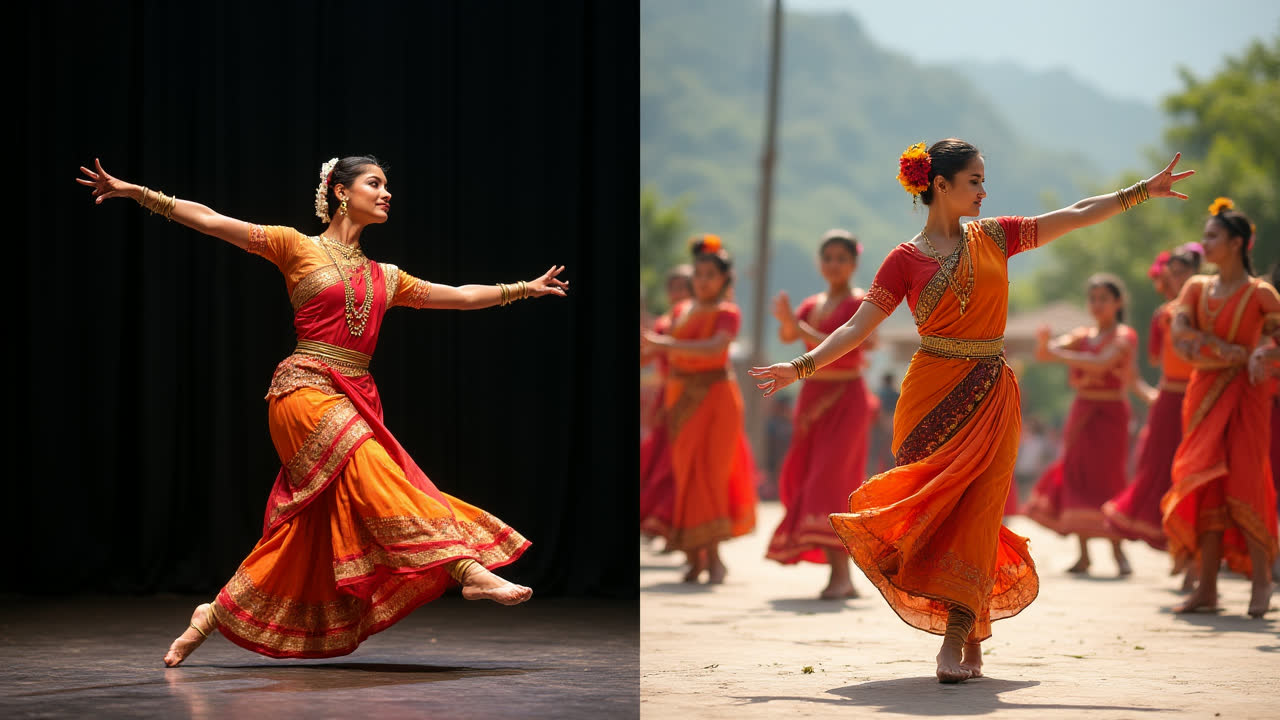
The most obvious difference? Well, jumping into a folk dance circle feels like joining a family reunion—everyone's welcome, and you learn as you go. But classical dance? That's more like studying medicine. It's precise, it takes years of training, and there's no room for improvisation.
What Exactly is Classical Dance?
When we talk about classical dance, we're talking about something that's been cultivated and refined for centuries. I once read that classical dance forms in India can trace their origins back to the Natyashastra—a nearly 2,000-year-old Sanskrit text on performing arts. That's right, people were writing detailed manuals about dance while the Roman Empire was still expanding!
The thing about classical dance is its incredible attention to detail. Every gesture, every eye movement, every facial expression has meaning. It's not just dancing; it's storytelling through movement. When a classical dancer performs, they're not just moving to music—they're narrating an ancient tale, expressing complex emotions, or depicting mythological characters.
For instance, I remember watching a Bharatanatyam performance where the dancer portrayed the emotions of a warrior. Every single finger position represented different weapons and battle strategies. That's the level of precision we're talking about!
Training for classical dance isn't something you can rush. Most dancers start training as children, spending 10-15 years perfecting their craft before they're considered performance-ready. It's like becoming a brain surgeon, but for your body. The Guru-Shishya tradition means you learn one-on-one from a master, absorbing not just techniques but also the philosophy behind each movement.
Understanding Folk Dance in Its True Spirit
Now, let's shift gears to folk dance. If classical dance is a refined art form, folk dance is life itself. I've participated in Garba nights during Navratri, and let me tell you—you don't need a degree to dance. The energy is infectious, and before you know it, you're spinning and clapping along with hundreds of others.
Folk dances emerged from the daily lives of common people. They celebrate seasons, harvests, weddings, and regional festivals. There's something beautifully democratic about folk dance—it belongs to everyone. Whether you're a farmer, a teacher, or a student, you can join in and be part of the community celebration.
What makes folk dance special is its informality. There's no strict choreography to memorize or complex techniques to master. It's about joining hands, moving together, and celebrating life's moments. I've seen elderly people who might struggle with daily activities transform completely when the music starts—their bodies remember the rhythms they've danced to for decades.
The beauty of folk dance lies in its adaptability too. While each region has its traditional forms, people constantly add new elements, making it a living, breathing art form that evolves with the times.
Key Differences: A Side-by-Side Comparison
| Aspect | Classical Dance | Folk Dance |
|---|---|---|
| Training Requirements | Rigorous formal training for 10-15 years | No formal training needed |
| Technical Complexity | Highly technical with precise movements | Simple and accessible to all skill levels |
| Performance Style | Solo or small group, formal presentation | Large group participation, casual setting |
| Cultural Origin | Temple and royal court traditions | Village and community celebrations |
| Choreography | Fixed sequences with minimal improvisation | Flexible with room for creativity |
| Purpose | Artistic expression and storytelling | Social bonding and celebration |
| Music Accompaniment | Classical instruments with specific ragas | Local instruments with folk melodies |
| Number of Forms | 8 officially recognized forms | Hundreds of regional variations |
Major Classical Dance Forms of India
I find it fascinating that there are only 8 officially recognized classical dance forms in India, but each represents decades of cultural evolution. These aren't just dances—they're living histories of different regions:
- Bharatanatyam (Tamil Nadu) - Known for its grace and storytelling
- Kathak (Uttar Pradesh) - Famous for its spinning and rhythmic patterns
- Odissi (Odisha) - Characterized by its tribhangi stances
- Kathakali (Kerala) - The dramatic dance-drama with elaborate makeup
- Kuchipudi (Andhra Pradesh) - Known for its combination of dance and acting
- Sattriya (Assam) - The monastic dance tradition
- Manipuri (Manipur) - Featuring lyrical movements and beautiful costumes
- Mohiniyattam (Kerala) - The dance of the enchantress with flowing movements
Each of these forms has its own unique aesthetic, music, and traditions. It's like having eight different languages of dance, each telling stories in its own distinct way.
Popular Folk Dances Across India
Unlike classical dance, folk dances are countless in number, with each village sometimes having its own variation. Here are some popular folk dances that you might encounter:
- Bhangra (Punjab) - The energetic harvest dance
- Garba (Gujarat) - The circular dance of devotion
- Lavani (Maharashtra) - Known for its powerful rhythm
- Bihu (Assam) - Celebrating the agricultural seasons
- Ghoomar (Rajasthan) - The graceful swirling dance
- Dandiya (Gujarat) - The stick dance during Navratri
- Kalbelia (Rajasthan) - The snake charmer's dance
What strikes me about folk dances is how they're deeply connected to the land and the seasons. They're not just entertainment—they're cultural celebrations that mark important moments in agricultural and social life.
Cultural Significance and Modern Relevance
You might wonder, why should we care about these differences in today's digital age? Well, both classical and folk dances serve different but equally important cultural roles. Classical dance preserves our ancient artistic heritage, while folk dance keeps our community traditions alive.
In my opinion, we need both. Classical dance pushes the boundaries of what's possible with human movement, while folk dance ensures everyone has access to cultural expression. It's like having both museums and community centers—both serve society in their own unique ways.
Interestingly, I've noticed how modern choreographers are starting to blend these forms. You might see a contemporary performance that incorporates classical mudras (hand gestures) within a folk dance framework. It's creating something entirely new while respecting both traditions.
Frequently Asked Questions
Can anyone learn classical dance, or is it only for certain people?
While classical dance requires dedication and years of training, it's not restricted to any particular group. Anyone with passion, discipline, and commitment can learn classical dance. However, starting younger (around 5-7 years) is often recommended as it allows the body to develop the necessary flexibility and strength. That said, I've met people who started in their thirties and became accomplished dancers, though it required more dedication.
How long does it take to master a folk dance?
The beauty of folk dance is that you can learn basic steps in a single evening. Most folk dances are designed to be inclusive and accessible. However, to truly understand the cultural context and perform with authentic expression might take months or years, especially if you want to lead groups or teach others. The learning curve is much gentler than classical dance, making it perfect for community participation.
Do classical dancers ever perform folk dances?
Yes, many classical dancers also perform folk dances, especially in the context of cultural celebrations or fusion performances. In fact, classical dancers often bring additional grace and technique to folk performances. However, they usually adapt to the folk style's informality and community spirit rather than imposing classical precision on the folk format.
Looking back at my own journey with Indian dance forms, I realize that both classical and folk dances have enriched my understanding of culture in different ways. Classical dance taught me discipline and the depth of artistic expression, while folk dance connected me to community and celebration.
Perhaps the real takeaway is this: whether you're watching a classical dance performance in a theater or joining a village folk dance circle, you're witnessing living history. These aren't just movements—they're stories, traditions, and cultural identities passed down through generations. And in today's world, where so much is becoming homogenized, isn't it remarkable that we still have these distinct forms of expression to celebrate?