Coleoptile vs Coleorhiza: Understanding Key Differences in Monocot Seeds
When it comes to understanding plant development, particularly in monocotyledonous plants like grasses and cereals, two important structures often come into play: the coleoptile and coleorhiza. These specialized protective sheaths play crucial roles during seed germination, yet many people struggle to distinguish between them. Have you ever wondered what exactly makes these structures different from each other? In this comprehensive guide, we'll explore everything you need to know about these fascinating plant structures.
The coleoptile and coleorhiza are both protective structures found in monocot seeds, but they serve distinctly different purposes during germination. Understanding these differences is essential for anyone studying plant biology, agriculture, or botany. Let's dive into the fascinating world of monocot seed germination and discover what makes these structures unique.
What is a Coleoptile?
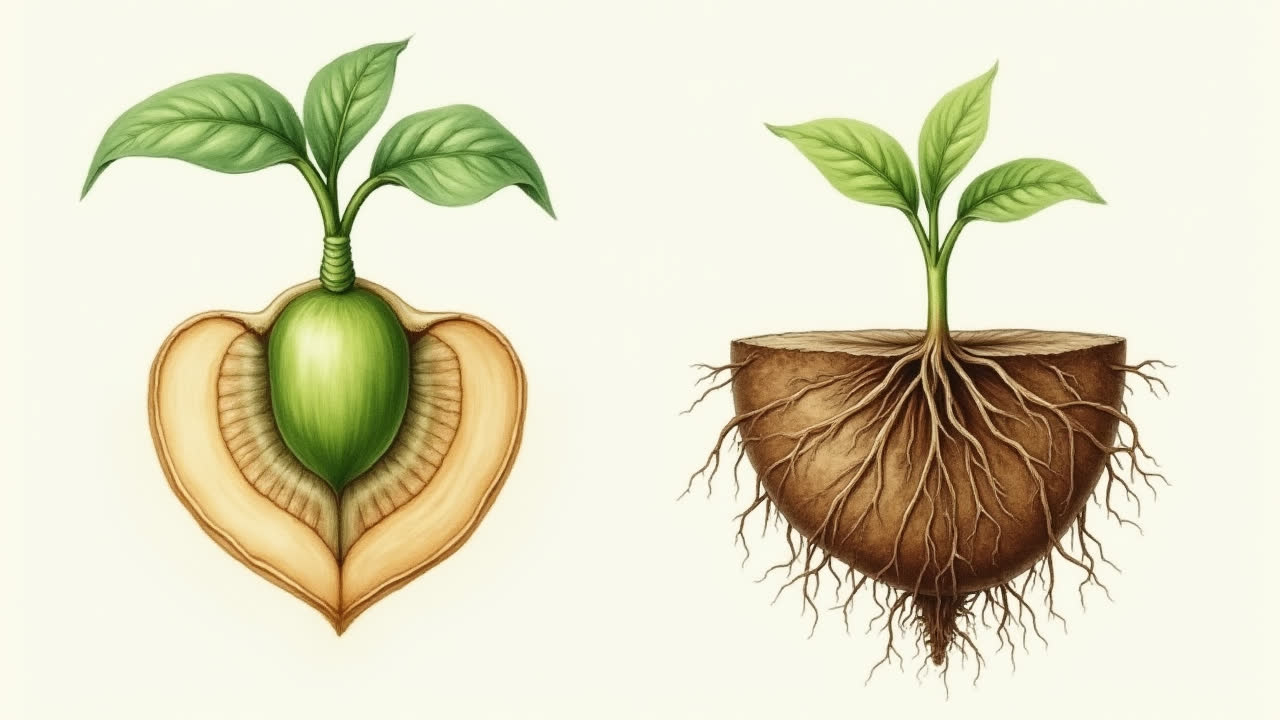
A coleoptile is a specialized protective sheath that surrounds and safeguards the emerging shoot (plumule) in monocot seeds during germination. Think of it as nature's helmet for the delicate shoot tip as it makes its journey upward through the soil. This hollow, cylindrical structure is the first part of the shoot to emerge from the seed and penetrate the soil surface.
The structure of the coleoptile is quite fascinating. It typically contains two vascular bundles positioned on opposite sides, which help transport water and nutrients. While initially pale in color due to minimal chlorophyll development, once the coleoptile emerges above the soil, it may develop a greenish hue as chlorophyll production increases. In some plant varieties, coleoptiles can also contain anthocyanin pigments, giving them a distinctive purple coloration that helps protect the emerging seedling from excessive light damage.
One of the most remarkable aspects of the coleoptile is its response to environmental stimuli. It exhibits strong phototropism (growing toward light) and negative gravitropism (growing against gravity). These responses are primarily mediated by the plant hormone auxin, which accumulates on the shaded side of the coleoptile, causing cells there to elongate more rapidly than those on the illuminated side. This differential growth results in the coleoptile bending toward the light source, helping guide the emerging shoot to sunlight.
As the seedling continues to develop, the primary leaves eventually penetrate through the tip of the coleoptile, which then typically ceases growth. At this point, having fulfilled its protective role, the coleoptile's function is complete, though it remains attached to the seedling for some time before eventually withering away. This transitional process marks an important step in the early development of monocot plants.
What is a Coleorhiza?
The coleorhiza is the counterpart to the coleoptile, but instead of protecting the shoot, it surrounds and protects the radicle (embryonic root) in monocot seeds. This sheath-like structure acts as a protective covering for the delicate root tip as it begins to grow during germination. The word "coleorhiza" comes from Greek, with "coleo" meaning sheath and "rhiza" meaning root.
Unlike the coleoptile, the coleorhiza typically remains underground and does not elongate significantly during germination. It serves as a temporary protective structure that the radicle must penetrate as it grows downward into the soil. Once the radicle breaks through the coleorhiza, this protective sheath generally stops growing and remains attached to the seed near the base of the developing root system.
The coleorhiza plays several important roles during early seed germination. First, it protects the delicate root meristem from mechanical damage as the radicle navigates through potentially abrasive soil particles. Second, it helps regulate water uptake during the critical early stages of germination. And third, it may contain specific enzymes that assist in breaking down the seed coat and endosperm, making nutrients available to the developing embryo.
Interestingly, while the coleorhiza lacks chlorophyll and never develops into a photosynthetic structure, research has shown that it can still respond to environmental signals. For example, the coleorhiza can sense moisture gradients in the soil, which helps direct root growth toward water sources. This sensory capacity, combined with its protective function, makes the coleorhiza much more than just a simple covering—it's an adaptive structure that contributes significantly to successful seedling establishment.
Detailed Comparison Between Coleoptile and Coleorhiza
| Characteristic | Coleoptile | Coleorhiza |
|---|---|---|
| Definition | Protective sheath covering the emerging shoot (plumule) | Protective sheath covering the embryonic root (radicle) |
| Location | Surrounds the first leaf or plumule | Surrounds the radicle and root cap |
| Growth pattern | Elongates significantly and emerges above ground | Limited growth, remains underground |
| Pigmentation | May develop chlorophyll (green) or anthocyanin (purple) | Lacks photosynthetic pigments |
| Response to stimuli | Exhibits phototropism and negative gravitropism | Responds to moisture gradients in soil |
| Vascular structure | Contains two vascular bundles | Undifferentiated, lacks vascular tissue |
| Duration of function | Functions until the first true leaf emerges | Functions only during initial root emergence |
| Final fate | Eventually withers after seedling establishment | Remains at the base of the root system |
The Importance of Coleoptile and Coleorhiza in Plant Development
Both the coleoptile and coleorhiza play critical roles in the successful establishment of monocot seedlings. Their protective functions help ensure that the delicate meristematic tissues of the emerging shoot and root can navigate through soil without damage. This protection is especially important considering that the soil environment can be quite harsh, with abrasive particles, potential pathogens, and varying levels of moisture and nutrients.
In agricultural contexts, understanding these structures has practical implications. For instance, planting depth recommendations for various grain crops are often based on coleoptile length. If seeds are planted too deeply, the coleoptile may not be able to reach the soil surface before it stops growing, resulting in failed emergence. Similarly, seed treatments and coatings must be designed with consideration for how they might affect the coleorhiza's ability to interact with soil moisture and microorganisms.
Modern plant breeding programs sometimes specifically target coleoptile traits. Varieties with longer coleoptiles allow for deeper planting, which can be advantageous in dry conditions where moisture may only be available at greater soil depths. The genetic basis for coleoptile and coleorhiza development has become better understood in recent years, opening new possibilities for crop improvement.
Have you ever noticed how uniformly cereal crops like wheat or corn emerge from the soil? This consistency is largely thanks to the coordinated development of the coleoptile and coleorhiza. The synchronization between upward shoot growth and downward root establishment helps create the balanced foundation that supports the plant throughout its life cycle. It's truly remarkable how these temporary structures, which function for just a brief period during germination, can have such profound effects on overall plant performance.
Common Misconceptions About Coleoptile and Coleorhiza
Despite their importance in plant biology, there are several common misconceptions about coleoptiles and coleorhizas that deserve clarification. One frequent misunderstanding is that these structures are unique to all flowering plants, when in fact they are specific to monocotyledons. Dicotyledonous plants (like beans, sunflowers, and most broadleaf species) have different protective mechanisms for their emerging shoots and roots.
Another misconception is that the coleoptile is actually the first leaf of the seedling. While it may appear leaf-like, especially as it emerges from the soil, the coleoptile is a specialized protective structure and not a true leaf. The first true leaves develop inside the coleoptile and eventually emerge from its tip. Similarly, some people mistakenly believe that the coleorhiza develops into the root system, when it actually remains distinct from the root and serves only a temporary protective function.
I've often heard people confuse the terms "coleoptile" and "coleorhiza" due to their similar spelling and related functions. An easy way to remember the difference is that "coleoptile" contains "opt," which can remind you of "optical" or "upward" (since it grows toward light), while "coleorhiza" contains "rhiza," which refers to "root" (as in "rhizome" or "mycorrhiza"). This simple memory trick has helped many of my botany students keep these terms straight.
Finally, there's a misconception that these structures are only relevant in wild plant species and have little importance in modern agriculture. In reality, understanding coleoptile and coleorhiza development is crucial for optimizing planting practices, developing improved seed treatments, and breeding varieties adapted to specific environmental challenges. Their study continues to yield insights that can contribute to agricultural productivity and sustainability.
Evolutionary Significance of Coleoptile and Coleorhiza
From an evolutionary perspective, the development of specialized protective structures like the coleoptile and coleorhiza represents an important adaptation in monocot plants. These structures likely evolved as solutions to the challenges of germination and seedling establishment in various terrestrial environments. By providing protection to the delicate meristematic tissues during the vulnerable early stages of growth, these modifications may have contributed to the remarkable success of grasses and other monocots across diverse habitats worldwide.
Interestingly, the presence and characteristics of coleoptiles and coleorhizas can vary somewhat across different monocot families, suggesting ongoing evolutionary refinement of these structures. For example, some grass species adapted to particularly harsh environments may have developed longer coleoptiles or more robust coleorhizas. These variations reflect the continuing processes of natural selection that shape plant adaptations to specific ecological niches.
The hormonal regulation of coleoptile and coleorhiza development offers another fascinating window into plant evolution. The complex interplay of plant hormones like auxin, gibberellins, and abscisic acid in controlling the growth and responses of these structures demonstrates sophisticated regulatory mechanisms that have evolved over millions of years. These same hormonal pathways have been harnessed by humans in agricultural practices and plant breeding programs.
When we consider that monocots include some of our most important food crops—such as rice, wheat, corn, barley, and oats—the evolutionary advantages conferred by structures like the coleoptile and coleorhiza take on additional significance. The successful domestication and improvement of these crops over thousands of years has been built upon the foundation of their natural adaptations, including their specialized germination strategies. Understanding the evolutionary context of these structures can thus inform our approaches to crop improvement and sustainable agriculture.
Frequently Asked Questions About Coleoptile and Coleorhiza
Why are coleoptile and coleorhiza only found in monocot plants?
Coleoptile and coleorhiza are specialized structures that evolved specifically in monocotyledonous plants as adaptations for successful seed germination. These structures are part of the unique embryonic development pattern in monocots, which differs significantly from that of dicots. In monocot seeds, the single cotyledon typically remains within the seed to absorb nutrients from the endosperm, while the coleoptile and coleorhiza emerge to protect the developing shoot and root, respectively. Dicots, on the other hand, have a different germination strategy where the two cotyledons often emerge above ground and become photosynthetic, eliminating the need for these specialized protective sheaths. This fundamental difference in embryo organization and germination strategy explains why these structures are exclusive to monocots.
How do environmental factors affect coleoptile and coleorhiza development?
Environmental factors significantly influence the development of both coleoptile and coleorhiza. Temperature is perhaps the most critical factor, with each plant species having an optimal temperature range for germination. Within this range, coleoptile and coleorhiza development proceeds most efficiently. Moisture availability directly affects the hydration of tissues and the activation of enzymes necessary for growth. Light conditions primarily affect the coleoptile, which exhibits phototropism and will bend toward light sources, while also influencing the rate of chlorophyll development once it emerges from the soil. Soil conditions, including compaction, texture, and nutrient status, can affect the ability of both structures to penetrate through the substrate. Finally, seed planting depth has a particularly strong effect on coleoptile elongation—seeds planted too deeply may fail to emerge if the coleoptile reaches its maximum length before reaching the soil surface.
Can coleoptile and coleorhiza characteristics be modified through plant breeding?
Yes, coleoptile and coleorhiza characteristics can indeed be modified through plant breeding efforts. Plant breeders have successfully developed varieties with longer coleoptiles, which allow for deeper planting in dry soils where moisture may only be available at greater depths. This trait has been particularly valuable in dryland wheat farming systems. Similarly, breeding for improved coleorhiza characteristics has focused on enhancing early root establishment and stress tolerance. Modern approaches, including marker-assisted selection and genomic tools, have accelerated the identification of genetic regions controlling these traits. For example, specific genes affecting coleoptile length and coleorhiza enzyme activity have been identified in various cereal crops. These advances are opening new possibilities for developing varieties with optimized germination characteristics tailored to specific agricultural environments and practices.
Conclusion
Understanding the differences between coleoptile and coleorhiza provides valuable insights into the fascinating world of plant development, particularly in monocotyledonous species. While both structures serve protective functions during germination, they differ significantly in their location, growth patterns, and ultimate fates. The coleoptile shields the emerging shoot and grows upward toward light, eventually turning green before being penetrated by the first true leaves. In contrast, the coleorhiza protects the radicle, remains underground, and ceases growth shortly after the root emerges.
These seemingly simple protective sheaths represent millions of years of evolutionary refinement and contribute significantly to the remarkable success of monocot plants across diverse environments worldwide. Their study continues to yield insights relevant to agricultural practices, plant breeding efforts, and our fundamental understanding of plant biology. Next time you see a grass seedling emerging from the soil, take a moment to appreciate the invisible yet crucial roles that the coleoptile and coleorhiza played in its successful establishment.