How to Identify Fake Currency Notes: 12 Foolproof Ways to Spot Counterfeits
Have you ever received change and felt something wasn't quite right about one of the bills? The global problem of fake currency affects millions of people each year, and knowing how to identify counterfeit notes could save you from significant financial loss. I've been studying currency security features for years, and I'm always amazed at how sophisticated modern banknotes have become - all to stay one step ahead of counterfeiters.
Counterfeit money doesn't just hurt individuals; it damages entire economies. When fake bills circulate, they reduce the value of legitimate currency and erode trust in the monetary system. I remember my cousin who runs a small convenience store telling me how a single fake $50 bill cut into his entire day's profit margin. That's why understanding how to detect suspicious notes is crucial for everyone who handles cash.
In this comprehensive guide, I'll walk you through practical, easy-to-apply techniques that can help you spot counterfeit bills from various countries. These methods don't require special equipment - just your eyes, fingers, and sometimes a simple light source. Ready to become a counterfeit-spotting expert? Let's dive in!
Why Knowing How to Spot Fake Money Matters
Before jumping into specific techniques, let's talk about why this skill is so important. The unfortunate reality is that once you accept counterfeit money, you're generally stuck with the loss. Banks won't exchange it for real currency, and knowingly passing it along to someone else is illegal in most countries. I've heard heartbreaking stories of small business owners who lost hundreds of dollars before realizing they were accepting fake bills.
Modern counterfeiting operations have become increasingly sophisticated, using advanced printing technologies that can create convincing fakes to the untrained eye. According to various estimates, millions of counterfeit notes circulate globally at any given time. The U.S. Secret Service alone seizes billions in fake currency annually, but plenty still slips through.
What's particularly concerning is that counterfeiters often target everyday people rather than banks or institutions with detection equipment. They might use fake bills at busy markets, festivals, or small shops where cashiers are rushed and less likely to scrutinize each note carefully. That's why developing a quick routine for checking currency can protect you from becoming their next victim.
Having examined countless genuine and counterfeit notes over the years, I've found that most fakes fail at least two or three security tests. The trick is knowing which features to check and making this verification a habit whenever you handle larger denominations or receive money in poorly lit conditions.
Universal Methods to Identify Fake Currency Notes
While each country's currency has unique security features, there are several universal tests that work for most major currencies around the world. These preliminary checks take just seconds but can save you from accepting worthless paper:
The Touch and Feel Test
Authentic banknotes have a distinctive feel that's hard to replicate. Real currency is printed on special paper made from cotton fibers (not wood pulp like regular paper), giving it a crisp, slightly textured feel with a certain snappiness when flicked. When I first started working as a cashier in college, my manager had me handle stacks of verified bills just to develop this tactile memory.
Counterfeit notes often feel smoother or softer than genuine currency. Sometimes they feel too slick or waxy due to the different printing processes used. I've also noticed that fakes sometimes have uneven thickness or lack the slight raised texture that comes from intaglio printing (where ink sits above the paper's surface).
Visual Inspection Under Good Light
Simply holding a note up to natural light can reveal several issues with counterfeits. Look for proper alignment of all design elements, crispness of printing, and correct coloration. Authentic bills have incredibly detailed, sharp printing with fine lines and microprinting that's difficult to reproduce accurately.
I once spotted a fake $20 because the portrait looked slightly blurry compared to genuine notes. The counterfeiters had done a decent job with the color and paper, but they couldn't match the precise printing quality. Another telltale sign is when colors appear flat rather than having the slight variation and depth seen in genuine notes.
The Watermark Check
Most modern currencies include watermarks visible when held up to light. These subtle images are created during the paper manufacturing process - not printed - making them particularly difficult to fake effectively. When examining a suspicious note, hold it up to light and look for the characteristic watermark that should match the printed portrait or design element.
Counterfeiters sometimes try to simulate watermarks by printing pale images on the paper, but these fake watermarks are typically visible even without backlighting and lack the subtle graduation of genuine watermarks. If you can see a watermark-like image when the bill is flat on a surface, that's often a sign of a counterfeit.
Country-Specific Security Features
How to Identify Fake Indian Currency
Indian rupee notes have several distinctive security features that make counterfeiting difficult. The security thread in genuine Indian notes appears as a continuous line when held up to light and contains the words "RBI" and "BHARAT" (India) visible under magnification. This thread changes color when viewed from different angles in higher denominations.
Another key feature is the raised printing or intaglio marks. On authentic Indian currency, you can feel raised printing by running your finger over the note, especially on the text "भारत" and "INDIA" as well as the denomination numerals. The Reserve Bank of India has also incorporated denomination-specific geometric shapes in intaglio for visually impaired individuals - a circle for ₹500, a triangle for ₹100, and a square for ₹50.
When I visited India a few years back, a shopkeeper showed me how to check the watermark on Indian currency - it features Mahatma Gandhi's portrait and should be visible when held against light. He also pointed out that genuine notes have a color-shifting windowed security thread that appears green when tilted.
Identifying Counterfeit US Dollars
The US dollar is one of the most counterfeited currencies worldwide due to its global acceptance. Authentic US bills incorporate color-shifting ink on the denomination numeral in the bottom right corner of most bills. On genuine notes, this number changes from copper to green when tilted - a feature that basic printers cannot reproduce.
Security threads are embedded vertically in genuine US bills and glow specific colors under ultraviolet light depending on the denomination. For example, the $20 bill's security thread glows green, while the $100 bill's thread glows pink. Each denomination also has a specific position for this thread.
US currency also features microprinting that appears as a solid line to the naked eye but contains tiny text when viewed with magnification. On a $20 bill, you can find "THE UNITED STATES OF AMERICA" written in microprint around the borders of the portrait. Without a microscope, counterfeiters often can't reproduce this feature accurately.
Spotting Fake British Pounds
British pound notes incorporate some of the world's most advanced security features. The newer polymer notes include a clear window with metallic elements and changing holographic images. When I lived in London, I was initially confused by how different these notes felt compared to paper currency, but this polymer material actually makes counterfeiting much more difficult.
One distinctive feature of genuine British pounds is the raised lettering. You can feel the words "Bank of England" raised on the front of the note. Additionally, authentic pounds have a metallic thread embedded in the paper that appears as a continuous dark line when held up to light.
The hologram on British notes changes between different images when tilted. For example, on the £20 note, it shifts between the word "Twenty" and the pound symbol. This feature uses specialized printing technology that's extremely difficult for counterfeiters to simulate accurately.
Comparison of Security Features: US Dollars vs. Euro
| Security Feature | US Dollar | Euro |
|---|---|---|
| Paper Composition | 75% cotton, 25% linen blend | 100% cotton |
| Color-Shifting Ink | Denomination numeral changes from copper to green when tilted | Hologram patch shows denomination and € symbol changing colors |
| Watermark | Portrait watermark matching the printed portrait | Portrait of Europa (Greek mythology) and denomination numeral |
| Security Thread | Embedded thread glows specific color under UV light based on denomination | Embedded thread appears as dark line with "€" symbol and denomination |
| Microprinting | Tiny text around portrait and on security features | Microtext on various parts of the note visible under magnification |
| Raised Printing | Tactile raised ink on portraits and Federal Reserve/Treasury seals | Raised print on edges and main image feels rough to touch |
| Special Elements | Color-shifting 3D security ribbon on $100 bills | Portrait window visible when held against light |
| UV Light Features | Security thread glows denomination-specific color | Fibers embedded in paper glow red, blue, and green |
Advanced Detection Methods
While the basic techniques I've covered will help you spot most counterfeits, there are some additional methods that can provide extra certainty when dealing with suspicious notes:
Ultraviolet (UV) Light Verification
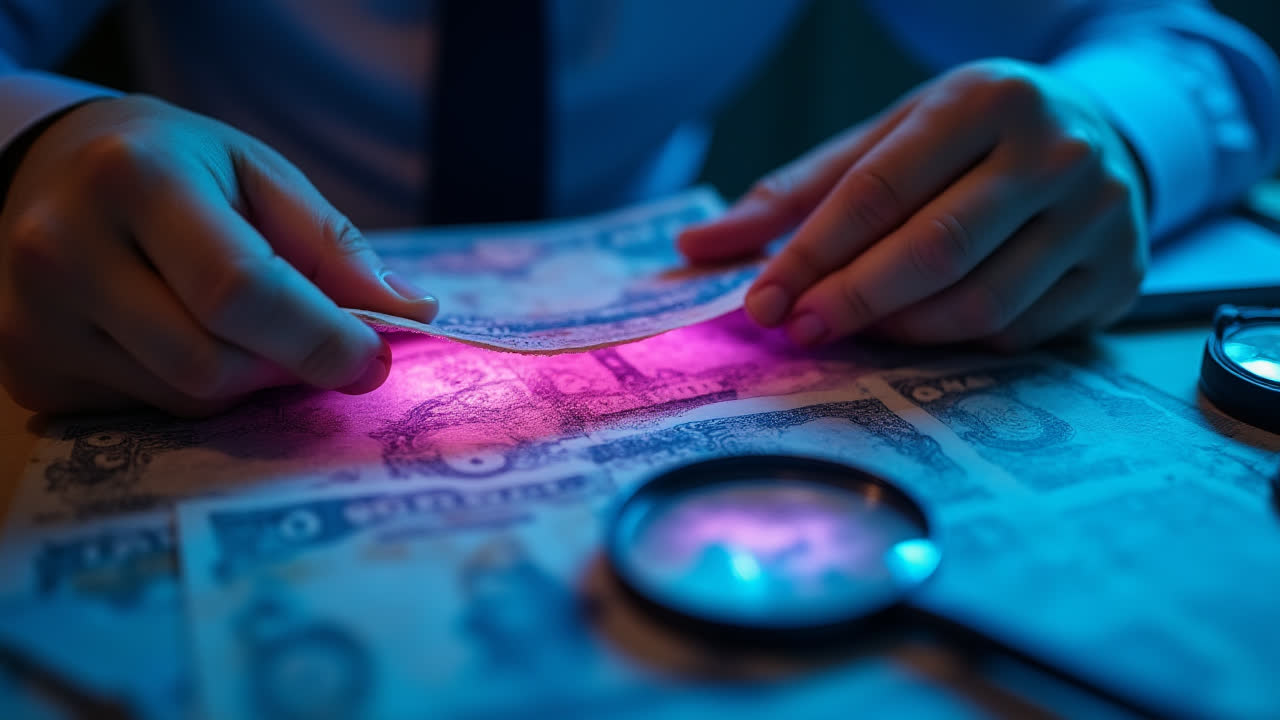
Most modern currencies include features that are only visible under ultraviolet light. For example, authentic US dollars contain security threads that glow different colors under UV light depending on the denomination, while genuine Euros have fibers that glow specific colors when exposed to UV. Small UV lights are relatively inexpensive and can be a worthwhile investment for businesses that handle large amounts of cash.
I remember visiting a night market in Thailand where every vendor had a small UV light attached to their cash box. They would quickly scan any large bills under this light before accepting them - it took just a second but provided substantial protection against counterfeits circulating in tourist areas.
Magnification Examination
Using a simple magnifying glass allows you to check for microprinting - tiny text that appears as a solid line to the naked eye. Genuine currency often contains microprinted words or phrases in key areas. For instance, on authentic US $20 bills, you can find "THE UNITED STATES OF AMERICA" repeated in tiny print around the portrait border.
Counterfeiters typically can't reproduce this microprinting clearly; under magnification, their attempts often appear blurry or as solid lines rather than distinct text. A jeweler's loupe or even the camera zoom on a smartphone can work well for this verification.
Infrared and Magnetic Features
Many currencies incorporate magnetic inks and infrared-reactive elements that can be detected with specialized equipment. While these tools aren't practical for individual consumers, businesses handling large volumes of cash often invest in multi-feature currency detectors that can check for these characteristics simultaneously.
During a bank internship, I observed how tellers used these devices for quick verification of large deposits. The machine would scan each note in seconds, checking multiple security features and flagging any suspicious bills for manual inspection. For high-risk businesses, these devices can pay for themselves by preventing even a single significant loss.
What to Do If You Suspect Counterfeit Money
If you believe you've received a counterfeit note, it's important to handle the situation carefully. Never return the suspected counterfeit to the person who gave it to you, as this could put you at risk or simply allow them to victimize someone else. Instead, in most countries, you should:
- Avoid drawing attention to the situation if you're dealing directly with a potential counterfeiter
- Note the person's description and any vehicle information if possible
- Handle the note minimally to preserve fingerprints and place it in a protective covering like an envelope
- Contact local law enforcement promptly
- Be prepared to provide details about when and how you received the note
I once witnessed this process firsthand when a colleague at a retail store received a suspicious $100 bill. She calmly completed the transaction (as per store policy) but immediately notified the manager, who contacted authorities. While it meant a financial loss for the store, they provided valuable information that helped identify a counterfeiting operation in the area.
It's worth noting that knowingly passing counterfeit currency is a serious crime in virtually all countries. Even if you innocently received fake money, once you realize it's counterfeit, attempting to spend it becomes a criminal offense. The financial loss from a counterfeit bill is unfortunate, but the legal consequences of trying to pass it along would be far worse.
Protecting Yourself from Counterfeit Currency
Developing the habit of quickly checking bills using the techniques we've covered is your best defense against accepting counterfeit money. I've found that a quick three-point check - feeling the paper, examining the watermark, and checking one additional security feature - takes just seconds but catches most counterfeits.
Remember that counterfeits are most commonly passed in situations where people are distracted, rushed, or in poorly lit environments. Be especially vigilant when handling cash in these circumstances. And while large denominations are most frequently counterfeited, don't overlook the possibility of fake smaller bills, which might face less scrutiny.
The technology battle between currency designers and counterfeiters continues to evolve, with security features becoming increasingly sophisticated. Staying informed about the security elements in the currencies you handle regularly is worth the small investment of time. After all, a fake bill accepted is money lost - and that's a lesson most of us would prefer to avoid learning firsthand.
Have you ever encountered counterfeit money? What gave it away? Developing an eye for the subtle details of genuine currency might save you from a costly mistake someday.
Frequently Asked Questions
What happens if I accidentally deposit counterfeit money at a bank?
If you unknowingly deposit counterfeit money at a bank, the bank will detect the fake bills during processing and confiscate them. Unfortunately, you won't receive credit for the counterfeit notes, and the bank is required to report them to authorities. They'll likely ask you about where you received the money, but if it was truly accidental, you won't face legal consequences. The bank will provide you with a receipt acknowledging the confiscation of suspected counterfeit currency. This situation highlights why it's important to check cash before accepting it, as you typically can't recover losses from accepting counterfeit money.
Are counterfeit detection pens reliable for spotting fake currency?
Counterfeit detection pens have significant limitations and shouldn't be your only method for verifying currency. These pens contain an iodine solution that reacts with starch in standard wood-based paper, turning the mark dark brown or black on counterfeit bills printed on regular paper. However, they cannot detect sophisticated counterfeits printed on paper with similar composition to real currency, such as bleached lower-denomination bills. Many modern counterfeits will pass a pen test while failing other security checks. For better protection, always combine the pen test with examining watermarks, security threads, and other advanced features that sophisticated counterfeits typically can't replicate accurately.
Which currencies are most frequently counterfeited worldwide?
The most frequently counterfeited currencies worldwide are the US Dollar, Euro, British Pound, and Chinese Yuan, primarily due to their widespread use in international trade and high value. The US $100 bill is particularly targeted, with the Federal Reserve estimating that about 80% of all $100 bills circulate outside the United States, making them difficult to track. The Euro is the second most counterfeited currency, with the €20 and €50 notes being common targets due to their high circulation and lower scrutiny compared to €100 notes. Counterfeiters typically focus on currencies with strong global acceptance, as these provide more opportunities to pass fake notes in regions where people might be less familiar with the security features. Currency authorities continuously update security features to stay ahead of counterfeiters.